
⚠️ Keep this link with you at all times.
Highlights from previous version: Instructor Notices Updated
Highlights from previous version: Instructor Notices Updated
⚖️ Safety, Just Culture and Compliance Monitoring Policy Statements🫂 Organization, roles, and responsibilities🏛️ Organizational Diagram / Organigram👑 Roles and Responsabilities🎯 Safety Objectives🆘 Emergency Response Planning (ERP)🛟 Safety Risk Management (SRM) process including roles and responsibilities & Occurrence reporting principles 🏃♂️ Reaction to a Safety Problem👆 Change Requests☎️ Cross-Departmental Safety Information Management🏢 WebCity📝 Instructor Notices.WebCity available sections:🕹️ FSTD SUITABILITY🙏 Your feedback is valuable
🧑🎓 At the end of the training, you are expected to be able to answer the following questions? If your training is delivered by an instructor supervisor you will be contacted either by Cesare Ricci or Martin Heun.
# | Question |
1 | Where can you find Swan Fly Estonia’s Safety Policy? |
2 | How do you initiate a Safety Occurrence Report (SOR), and what type of events must be reported? |
3 | How can you propose a change to procedures, manuals, or training content within the ATO? |
4 | What should you do if the simulator becomes unserviceable before or during training? |
5 | What actions must you take in case of an Emergency Response (ERP) activation? |
6 | Who is your point of contact for any questions related to the Safety Management System (SMS)? |
7 | What is your responsibility regarding student safety reporting encouragement? |
8 | Where are approved procedures, manuals, and reporting tools officially located? |
9 | In one sentence, define your role in maintaining Swan Fly Estonia’s safety culture. |
⚖️ Safety, Just Culture and Compliance Monitoring Policy Statements
0.6 Safety Policy
Expand
- Core Value: Safety is a principal core business value.
- Commitment: Continuously improve safety strategies and processes.
- Responsibility: All management levels and staff are responsible for safety.
- Equal Priority: Safety is managed equally with technical, financial, and sales dimensions.
- Resources: Allocate appropriate resources for safety management.
- Clear Roles: Define accountabilities and responsibilities for safety.
- Objectives: Set ambitious yet realistic safety objectives.
- Hazard Management: Operate hazard identification and risk management processes.
- Compliance: Exceed legislative and regulatory requirements when possible.
- Training: Ensure sufficient skilled and trained personnel.
- Task Allocation: Assign tasks matching staff skills.
- Performance Assessment: Use safety performance indicators to assess performance.
- Supplier Compliance: Ensure externally supplied systems meet safety targets.
- Continuous Improvement: Regularly improve safety performance through effective actions.
- Non-Punitive Reporting: No action against staff for reporting safety concerns unless involving illegal acts or gross negligence.
- Robust Procedures: Evaluate the robustness of procedures when non-compliance occurs.
- Information Exchange: Commit to open and free exchange of safety information.
0.7 Just Culture Policy
Expand
- Highest Standards: Committed to operating according to the highest safety standards.
- Uninhibited Reporting: Encourage reporting of accidents, incidents, hazards, and risks.
- No Reprisal: Reporting is free of any form of reprisal.
- Purpose: Focus on risk control and prevention, not blame.
- Protection: Protect the identity of reporters to the extent permissible by law.
- Action on Reports: No action against staff unless involving illegal acts or gross negligence.
- Consideration: Open reporting considered in outcomes but does not inhibit information exchange with ETA.
0.8 Compliance Policy
Expand
- Regulatory Adherence: Operate in compliance with Regulation (EC) 2018/1139 and its Implementing Rules.
- Acceptable Means of Compliance: Maintain compliance with EASA’s Acceptable Means of Compliance unless approved alternatives are developed.
- Compliance Monitoring: Subject to oversight by the Compliance Monitoring System.
- Guidance by Results: Accountable Manager guided by compliance monitoring results.
- Empowerment: All personnel empowered to act within the regulatory framework.
- Exclusive Authority: No management authority to request actions outside the regulatory framework unless for flight safety under company manual instructions.
Remember! The signed policies can be found in WebCity!
🫂 Organization, roles, and responsibilities
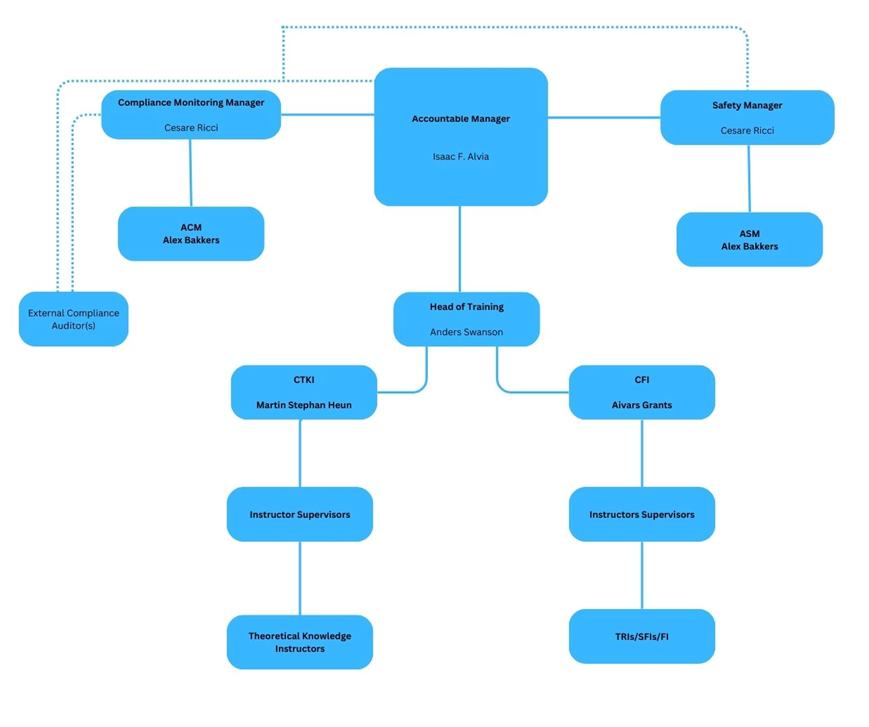
🏛️ Organizational Diagram / Organigram
Organizational Diagram / Organigram
Are you a TKI ?
You are under the oversight of either the CTKI or your Instructor Supervisor. While Swan Fly has established procedures for Instructor Supervisors, no active TKI supervisors have been assigned yet. Therefore, you should have direct access to the following Nominated Persons:
- Martin Heun (CTKI): m.heun@swan-fly.com
- Anders Swanson (HT): ht@swan-fly.com
Are you a TRI/SFI / Instructor Supervisor?
You are under the oversight of either the CFI or your Instructor Supervisor. While Swan Fly has established procedures for Instructor Supervisors, no active TRI/SFI supervisors other than the CTKI have been assigned yet. Therefore, you should have direct access to the following Nominated Persons:
- Aivars Grants (CFI): cfi@swan-fly.com
- Anders Swanson (HT): ht@swan-fly.com
If you have difficulties establishing contact with the above, contact Martin Heun, and he will facilitate direct access to any of them.
👑 Roles and Responsabilities
Your Duties
Duties of the Instructor:
3.6 FLIGHT AND SYNTHETIC FLIGHT INSTRUCTORS.
The following information applies to all instructors involved in the provision synthetic flight instruction unless otherwise stated.
Note – unless otherwise stated, the requirements of Synthetic Flight Instructors are equally applicable to Type Rating Instructors who are engaged in the provision of instruction on an FSTD.
Prerequisites for TRIs and SFIs are stated in OMD Chapter 2
3.6.1 Duties of Instructors
Notwithstanding any additional lawful requests made by the HT, the duties of flight or synthetic flight instructors are as follows:
To comply with the requirements of Swan Fly Estonia published manuals as well as striving to impart the highest professional level of knowledge and skill upon Swan Fly Estonia students.
To report any discrepancy and suggest changes and/or improvements directly to the Head of Training and/or the Compliance Monitoring Manager and/or the Safety Manager in accordance with the company reporting procedures described in OMM Chapter 12,
Ensure lessons are planned ahead of the intended lesson, and materials, as may be required, are prepared, available and training aids (where used) are serviceable.
To ensure that aircraft and/or FSTD (as applicable) are equipped as required in the training specification for the lesson/exercises to be taught and that such equipment as required is serviceable.
To ensure students are familiar with all practical procedures with the flight and synthetic flight lessons to be taught.
To comment and sign each lesson in the Student Training Record, including a detailed narrative report of the lesson taught, and to ensure that any items not covered (for whatever reason) are clearly itemized in the training file so that they may be covered in subsequent lessons/sessions. Additionally, comments shall include recommendations for subsequent lessons where such recommendations are considered pertinent (e.g. recommended repetition of certain exercises).
3.7 THEORETICAL KNOWLEDGE INSTRUCTORS.
Prerequisites for TKIs are detailed in OMD Chapter 2
3.7.1 Duties of Theoretical Knowledge Instructors
The duties and responsibilities of Theoretical Knowledge Instructors are to:
To comply with the requirements of Swan Fly Estonia published manuals as well as striving to impart the highest professional level of knowledge (and where applicable) skill upon Swan Fly Estonia students.
Report any discrepancies to the CTKI or HT (as applicable) and suggest changes for improvements through the established communication channels described in OMM Chapter 12.
Ensure lessons are planned ahead of the intended lesson, and materials, as may be required, are prepared, available and training aids (where used) are serviceable.
Follow-up the progress of individual students and in cases of a student having any problem, report to the CTKI/HT (as applicable).
Ensure the actual classroom, when used, meets the requirements as stated in OMM Chapter 5.1.
Ensure the virtual classroom, when used, meets the requirements as stated in OMM Chapter 5.2.
3.8 INSTRUCTOR SUPERVISORS
The duties of Instructor Supervisors align with those of Type Rating Instructors, Synthetic Flight Instructors, and Theoretical Knowledge Instructors, tailored to their supervisory scope. Additionally, Instructor Supervisors are tasked with the additional following key responsibilities:
Overseeing and evaluating instructor performance, ensuring alignment with training standards, and providing feedback to enhance instructional quality.
Completing the relevant documentation as required for the supervision of other instructors.
Actively engaging in meetings when convened by the HT/CTKI/CFI to stay updated on training methodologies, regulatory changes, and operational procedures.
Alternatively, confirming the acknowledgment of digitally disseminated information.
Completing specialized initial and recurrent training programs as stated in the OMM, Chapter 13.
Reporting deficiencies and suggesting improvements to the HT, CFI CTKI, aiming for continuous training optimization.
Monitoring the adherence to training protocols, ensuring the currency of materials.

Accountable Manager (AM)
Authority
Ensures all activities can be financed and meet applicable requirements.
Responsibilities
- Establish and maintain an effective management system.
- Ensure all training tasks comply with regulations.
- Grant access to ETA and EASA representatives for compliance verification.
- Oversee the Compliance Monitoring System and Safety Management System.
- Implement corrective actions from evaluations and audits.
- Ensure operations align with training needs and foster continuous improvement.
- Maintain professional standards and provide leadership in marketing.
- Establish and support a comprehensive Safety Management System.
- Approve the contents of the Organization Management Manual.
- Prepare annual investment and budget plans.

Head of Training (HT)
Role
Ensure training complies with regulatory requirements and manage instructional staff.
Responsibilities
- Authorize suitable instructors as Instructor Supervisors.
- Oversee training programs for professional pilot licenses and ratings.
- Ensure compliance with training standards and regulations.
- Collaborate with Deputy HT(s) for specific training courses if needed.

Compliance Monitoring Manager (CMM)
Role
Ensure organizational compliance with regulatory requirements.
Responsibilities
- Monitor compliance with technical standards and identify corrective actions.
- Evaluate the effectiveness of corrective actions.
- Report significant non-compliances to the competent authority.
- Manage and develop the Compliance Monitoring System.
- Participate in management evaluation activities.
- Ensure ongoing qualification of the ATO.
- Edit, amend, and update Compliance Monitoring documentation.
- Supervise personnel to ensure adherence to compliance procedures.
- Access all facilities, activities, and relevant managers.

Safety Manager (SM)
Role
Develop, administer, and maintain an effective Safety Management System (SMS).
Responsibilities
- Implement the SMS and promote a safety culture.
- Monitor compliance with safety regulations and provide evaluation reports.
- Maintain safety documentation and organize safety training.
- Collect and analyze safety information.
- Conduct hazard identification, risk assessments, and manage risks.
- Monitor industry safety concerns and update the Emergency Response Plan (ERP).
- Ensure continuous audits of the SMS and follow up on investigations.
- Attend Safety Review Board meetings.

Chief Flight Instructor (CFI)
Role
Supervise flight instruction and standardize all flight instruction.
Responsibilities
- Hold the highest professional pilot license and associated ratings for training courses.
- Delegate standardization and supervision to flight instructors if necessary.
- Ensure quality and standards in flight instruction.
- Meet specific experience requirements (e.g., minimum 1000 hours PIC, 500 hours instructional duties).

Chief Theoretical Knowledge Instructor (CTKI)
Role
Supervise theoretical knowledge instructors and standardize theoretical knowledge instruction.
Responsibilities
- Sign Training Manuals if requested by HT or AM.
- Act as an Instructor Supervisor with a valid TRI/SFI Certificate.
- Meet specific experience requirements (e.g., deliver theoretical courses of MCC, Type Rating, Teach and Learning).

Instructor Supervisors
Role
Oversee theoretical and flight/simulated training..
Responsibilities
- Managed by CTKI for theoretical training.
- Managed by CFI for flight/simulated training.
- Nominated by the HT.
🎯 Safety Objectives
Safety Objectives
- Meets or exceed regulatory requirements;
- Provide for students to be able to achieve highest training result;
- Promote safety reporting safety awareness throughout all phases of flight training.
🆘 Emergency Response Planning (ERP)
Emergency Response Planning (ERP)
14.1 ERP – General
- Purpose: Covers undefined crises with a flexible, adaptable framework.
- Crisis Management Team: Members listed in Appendix 14.1 are the primary contacts during emergencies.
14.2 Coordinating and Maintaining the ERP
- Contact Details: Crisis Management Team's contact details are in Appendix 14.1 (see below) and must be accessible and up to date.
- Responsibility: First contact disseminates alerts to personnel, customers, authorities, and other organizations.
- Crisis Log: All events, decisions, and actions during an emergency must be recorded (by SFE Management).
- Training: Initial and recurrent training includes ERP procedures for Crisis Management Team members.
- Coordination with Partners: Contracted organizations' ERPs take precedence for in-flight activities; continuous communication is essential.
14.3 Transition from Normal to Emergency Operations
- Activation Events: Includes aviation accidents, disasters, loss of resources, climatic events, natural disasters, health emergencies, social movements, threats, and other significant incidents.
- Levels of Severity:
- Level 1: Potentially hazardous, no immediate consequences; Crisis Management Team on alert.
- Level 2: Significant impacts; immediate response required.
- Action Plan: Developed using the SADIE Problem Solving model to ensure standardized decision-making.
- Roles and Responsibilities:
- Head of Training (HT) / Accountable Manager (AM):
- Implement and maintain the Action Plan.
- Inform personnel and ensure unaffected activities continue.
- Coordinate with official organizations.
- Chief Theoretical Knowledge Instructor (CTKI) / Compliance Monitoring Manager (CMM):
- Manage logistics, communication, and maintain a contact list.
- Update the Crisis Log and coordinate with involved parties.
- Safety Manager (SM):
- Analyze safety data and previous risk assessments.
- Provide conclusions to support company reputation.
- Update SMS information post-crisis.
14.4 Transition from Emergency to Normal Operations
- Stabilization: HT or AM decides when to return to normal operations, maintaining the ERP if in doubt.
- Deactivation Actions:
- Notify Crisis Management Team, emergency services, and other relevant parties.
- Record deactivation in the Crisis Log, including the rationale.
Appendix 14.1 On-call Management Member Roster
The following cascade system should be used to reach a member of Swan Fly Estonia management:
Head of Training: Anders Swanson: +46 70 7356662
Chief Theoretical Knowledge Instructor: Martin Heun +49 160 3778694
Accountable Manager: Isaac F. Alvira +34 610 98 28 25 / +352 655 002 084.
Compliance Monitoring Manager: Cesare Ricci +39 347 106 5023
Safety Manager: Cesare Ricci +39 347 106 5023
⚠️ Delivering IN-FLIGHT LIFUS TRAINING and an emergency situation is triggered?
🚨 If an emergency occurs during TRI LIFUS in-flight training, immediately follow the Operator’s Emergency Response Plan and procedures in full — the Operator’s ERP always takes precedence. Once the situation is stabilised, promptly inform Swan Fly Estonia ATO at compliance@swan-fly.com with essential details (operator, flight, event type, and actions taken). This ensures correct coordination between the Operator’s operational control and the ATO’s oversight responsibilities under OMM Chapter 14 and maintains full regulatory traceability.
⚠️ Are you performing FSTD/OTD training at a Training Center? → Familiarize yourself with the Training Center Emergency Procedures, available at WebCity or at the training facilities and always brief the students.
🚨 If an Emergency Situation Arises:
- Follow the Training Center Emergency Procedures as closely as possible.
- Ensure students are provided clear instructions, and assist them to safety following the protocols.
- Once the situation is stable, follow the SFE ERP.
- SFE will coordinate further actions with the training center.
Main Training Centers - Emergency Contacts
LAT (Lufthansa Aviation Training)
Isabelle Haderthauer
Tel: +49 (0)151 5895 3638
Email: haderthauer@lat.dlh.de
Frédéric Göpfardt
Tel: +49 (0)151 5894 0686
Email: goepfardt@lat.dlh.de
Air France
Emmanuella Ballarin
Tel: +33 (0)1 41 56 58 86
Email: emballarin@airfrance.fr
BAFT (British Airways Flight Training)
Praful Chauhan
Tel: +44 (0)7789 612062
Email: chauhan@ba.com
AFG Frankfurt
Ekaterina Batiaeva
Tel: +49 (610) 396 94 987
Email: ekaterinabatiaeva@afgsim.com
SIMAERO
Achraf Adima
Tel: +33 7 86 56 11 63
Email: adima@sim.aero
BAA Training
Violeta Simoniene
Tel: +370 630 36998
Email: v.simoniene@baatraining.com
🛟 Safety Risk Management (SRM) process including roles and responsibilities & Occurrence reporting principles
You must remember:
1. Who to inform in case of Emergency (compliance@swan-fly.com is accessible by all our managers).
2. Reporting procedures. Swan Fly Estonia Safety Occurrence Report LINK HERE.
1. Who to inform in case of Emergency (compliance@swan-fly.com is accessible by all our managers).
2. Reporting procedures. Swan Fly Estonia Safety Occurrence Report LINK HERE.
🏃♂️ Reaction to a Safety Problem
The Safety Manager and Accountable Manager are responsible for handling immediate reactions to safety problems by implementing, documenting, and verifying actions in response to safety directives issued by EASA. Upon receiving safety information, the Safety Manager logs and reviews the notifications, determines applicable actions, and ensures compliance, while the Accountable Manager oversees the process and convenes safety meetings if necessary.
Instructors are not required to perform any actions related to this process. However, if instructors notice that Swan Fly Estonia has not taken the necessary actions, they should initiate an Occurrence Report to ensure proper follow-up and compliance.
👆 Change Requests
Would you like to propose a change in our organization? Please fill the following form (also available in WebCity)
☎️ Cross-Departmental Safety Information Management
- Instructors at Swan Fly Estonia play a crucial role in cross-departmental safety information management.
- Instructors should contact the Safety Manager (SM) if they receive any safety-related information such as incident reports, hazards, or potential risks.
- The Compliance Monitoring Manager (CMM) can also be contacted for ensuring compliance with regulatory requirements.
- For immediate concerns or if the SM or CMM is unavailable, the Head of Training (HT) or the Accountable Manager (AM) should be contacted.
- Effective communication and proper management of safety information are key to the organization's Safety Management System (SMS).
- Prompt and effective communication of safety-related information contributes to a proactive risk management culture and the organization's overall safety performance.
Functional Area | Name | Contact Telephone |
Accountable Manager | Isaac F. Alvira | isaac@swan-fly.com +34 609 455 728 +352 655 002 084 |
Chief Theoretical Knowledge Instructor | Martin Heun | m.heun@swan-fly.com +49 160 3778694 |
Compliance Monitoring Manager | Cesare Ricci | c.ricci@swan-fly.com +39 347 106 5023 |
Safety Manager | Cesare Ricci | c.ricci@swan-fly.com +39 347 106 5023 |
Head of Training | Anders Swanson | ht@swan-fly.com +46 707356662 |
Chief Flying Instructor | Aivars Grants | cfi@swan-fly.com +371 26 429 168 |
Assistant Compliance Safety Manager | Alex Bakkers | a.bakkers@swan-fly.com +31 6 1479 3500 |
🏢 WebCity
📝 Instructor Notices.
🛟 All Safety Relevant news affecting the scope of your activities are available in WebCity. Always check!
📩 See ATO Notices.
ATO Notices
Table view
Title
Issue Date
Files & media

ATO Notes
Tags
Valid
Instructors Notified?
Nov 3, 2025
Summary of EASA SIB 2023-03R1 (22 October 2025)
Subject: Incorrect Barometric Altimeter Setting
Scope: Aircraft Operators and Air Navigation Service Providers (ANSPs)
Background:
Several serious incidents revealed that incorrect barometric altimeter settings during operations below the transition level can lead to insufficient terrain or obstacle clearance and loss of separation with other aircraft, potentially resulting in Controlled Flight Into Terrain (CFIT) or mid-air collisions.
The issue affects approach procedures relying on barometric vertical navigation (e.g. RNP APCH to LNAV/VNAV minima, RNP AR APCH, CDFA techniques). Incorrect settings may go undetected, as standard cross-checks in SOPs do not reveal the error.
Revision Note:
This bulletin revises the original SIB 2023-03 (09 March 2023) following additional reported incidents. The concern does not warrant a Safety Directive.
Key Recommendations:
For Aircraft Operators:
• Include procedures for verifying QNH/QFE consistency with ATIS or other sources.
• Evaluate and improve existing procedures; consider pre-selecting altimeters during approach briefings.
• Keep TAWS software and databases up to date.
• Explore methods within Flight Data Monitoring (FDM) to detect incorrect settings.
Additional Notes:
• Reinforces use of standard ICAO phraseology (Reg. (EU) 923/2012).
• Reminds operators and ANSPs to comply with occurrence reporting obligations (Reg. (EU) 376/2014).
Conclusion:
EASA emphasizes vigilance and improved procedural and technical defences to prevent incorrect barometric altimeter settings, which remain a significant operational risk during approach and landing.
Subject: Incorrect Barometric Altimeter Setting
Scope: Aircraft Operators and Air Navigation Service Providers (ANSPs)
Background:
Several serious incidents revealed that incorrect barometric altimeter settings during operations below the transition level can lead to insufficient terrain or obstacle clearance and loss of separation with other aircraft, potentially resulting in Controlled Flight Into Terrain (CFIT) or mid-air collisions.
The issue affects approach procedures relying on barometric vertical navigation (e.g. RNP APCH to LNAV/VNAV minima, RNP AR APCH, CDFA techniques). Incorrect settings may go undetected, as standard cross-checks in SOPs do not reveal the error.
Revision Note:
This bulletin revises the original SIB 2023-03 (09 March 2023) following additional reported incidents. The concern does not warrant a Safety Directive.
Key Recommendations:
For Aircraft Operators:
• Include procedures for verifying QNH/QFE consistency with ATIS or other sources.
• Evaluate and improve existing procedures; consider pre-selecting altimeters during approach briefings.
• Keep TAWS software and databases up to date.
• Explore methods within Flight Data Monitoring (FDM) to detect incorrect settings.
Additional Notes:
• Reinforces use of standard ICAO phraseology (Reg. (EU) 923/2012).
• Reminds operators and ANSPs to comply with occurrence reporting obligations (Reg. (EU) 376/2014).
Conclusion:
EASA emphasizes vigilance and improved procedural and technical defences to prevent incorrect barometric altimeter settings, which remain a significant operational risk during approach and landing.
YES
YES
Nov 3, 2025
In FFS 7, the training manual specifies that the Jammed Stabilizer exercise must be completed twice. This requirement resulted in the exercise being repeated in the provided Instructor Syllabus.
For training purposes, you may conduct the exercise with only one student and substitute the second occurrence with an alternative malfunction, such as HYD 2+4, during Part B of the training session.
This requirement will be amended in the next revision of both the training manual and the syllabus.
For training purposes, you may conduct the exercise with only one student and substitute the second occurrence with an alternative malfunction, such as HYD 2+4, during Part B of the training session.
This requirement will be amended in the next revision of both the training manual and the syllabus.
YES
YES
Oct 14, 2025
EASA has issued SIB 2025‑07 addressing the underutilisation of stop bars outside low-visibility procedures. Stop bars are often inactive under normal visibility, even at high‑risk aerodromes, despite their proven effectiveness in preventing runway incursions.
Several recent high-profile incidents (e.g., Tokyo Haneda, Bâle-Mulhouse, Toronto Pearson) involved inoperative or deactivated stop bars, contributing to serious incursion events.
Several recent high-profile incidents (e.g., Tokyo Haneda, Bâle-Mulhouse, Toronto Pearson) involved inoperative or deactivated stop bars, contributing to serious incursion events.
YES
YES
Sep 15, 2025
📘 Bi-Monthly Compliance & Safety Bulletin – September 2025 focuses on the new EASA ED Decisions 2025/013, /014, and /015 ✳️ introducing Part-IS (Information Security) implementation and guidance, encouraging all personnel to review the related ATO Notices 📎. It also announces the addition of the A320 ZFTT option to the ATO Certificate ✅, confirms that no new hazards were identified, and notes that internal and external audits (including TRAM’s TRI/SFI program audit) are ongoing. Three Level 3 findings from previous audits will be addressed in the next OMM revision, covering abbreviation harmonization, document revision processes, and residual risk recording. The FAA Instructor Bulletin (Jul–Aug 2025) emphasizes preventing safety drift and complacency, reinforcing checklist discipline 🧾, structured risk management (PAVE & FRAT), clear communication standards 🎧, and continuous alignment with SMS and human factors principles—key reminders for all instructors to uphold procedural excellence and proactive safety culture.
YES
Aug 27, 2025
This notice provides access to the EASA Annual Safety Review 2025, published by the European Union Aviation Safety Agency (EASA). The review presents a comprehensive overview of aviation safety performance in 2024 and identifies the main safety risks across all operational domains, including commercial air transport, general aviation, rotorcraft, unmanned aircraft systems, aerodromes, and ATM/ANS.
Key highlights of the report include:
• Accident and incident statistics across EASA Member States and globally.
• Identification of top risk areas such as crew error, aircraft upsets, runway excursions, and terrain collisions.
• Cross-domain comparisons, including commercial and non-commercial operations.
• Safety performance trends derived from the European Risk Classification Scheme (ERCS).
• The link between the review’s findings and the European Plan for Aviation Safety (EPAS).
The document is intended as a reference for instructors, examiners, and trainees to:
• Strengthen awareness of current aviation safety risks.
• Align simulator training and classroom instruction with identified risk areas.
• Support proactive safety management in line with EASA and ICAO safety frameworks.
Key highlights of the report include:
• Accident and incident statistics across EASA Member States and globally.
• Identification of top risk areas such as crew error, aircraft upsets, runway excursions, and terrain collisions.
• Cross-domain comparisons, including commercial and non-commercial operations.
• Safety performance trends derived from the European Risk Classification Scheme (ERCS).
• The link between the review’s findings and the European Plan for Aviation Safety (EPAS).
The document is intended as a reference for instructors, examiners, and trainees to:
• Strengthen awareness of current aviation safety risks.
• Align simulator training and classroom instruction with identified risk areas.
• Support proactive safety management in line with EASA and ICAO safety frameworks.
YES
Jul 10, 2025
📘 Bi-Monthly Compliance & Safety Bulletin – July 2025 highlights the importance of maintaining strong manual flying skills ✈️ as emphasized by recent EASA and FAA bulletins, and reminds all personnel to review the new ATO Notices 📎. It reports the approval of OMM Temporary Revision 4, new agreements with Challenge Airlines (B747 ZFTT) and Maersk Air Cargo (B777 TRI LIFUS), and progress toward OMM Issue 5 Rev 1, adding new partners including Azerbaijan Airlines CJSC, National Aviation Academy, Aviation Safety and Training Pte Ltd, and Marabu Airlines. ✅ No new hazards were identified, and internal audits continue as planned. The instructor newsletter emphasizes avoiding overreliance on automation, enhancing weather awareness 🌦️ through modern tools like ADS-B, G-AIRMETs, and GFAs, and staying updated with emerging tec
YES
Jul 9, 2025
Safety Bulletin_SIMAERO_UPRT Training .pdfSafety Bulletin - Mandatory Use of Seatbelts - July 15, 2025.pdf
This is a reminder to remain fully vigilant regarding safety and emergency procedures at all simulator centers where we operate.
Following a recent incident during UPRT training at a major training center, we kindly ask all instructors to:
• Ensure seatbelt use is strictly enforced for all occupants (instructors, trainees, observers, technicians, etc.) whenever the motion system is activated.
• Review and comply with local safety and emergency procedures specific to each simulator center. These must be clearly communicated during the pre-session briefing.
• Consult the Station Guides available in WebCity ahead of your training assignments to ensure you are familiar with center-specific protocols.
• Refer to the recent safety bulletin from SIMAERO regarding mandatory seatbelt use during motion-based training, especially for UPRT. Instructors scheduled at SIMAERO centers are expected to review this document carefully.
• In case of any questions or uncertainty, please contact our Safety and Compliance Manager, Cesare Ricci, at c.ricci@swan-fly.com.
Your commitment to safety is critical to delivering high-quality, compliant training across all locations. Thank you for your continued professionalism and cooperation.
Following a recent incident during UPRT training at a major training center, we kindly ask all instructors to:
• Ensure seatbelt use is strictly enforced for all occupants (instructors, trainees, observers, technicians, etc.) whenever the motion system is activated.
• Review and comply with local safety and emergency procedures specific to each simulator center. These must be clearly communicated during the pre-session briefing.
• Consult the Station Guides available in WebCity ahead of your training assignments to ensure you are familiar with center-specific protocols.
• Refer to the recent safety bulletin from SIMAERO regarding mandatory seatbelt use during motion-based training, especially for UPRT. Instructors scheduled at SIMAERO centers are expected to review this document carefully.
• In case of any questions or uncertainty, please contact our Safety and Compliance Manager, Cesare Ricci, at c.ricci@swan-fly.com.
Your commitment to safety is critical to delivering high-quality, compliant training across all locations. Thank you for your continued professionalism and cooperation.
YES
Jul 1, 2025
EASA SIB 2013-05R1 highlights concerns about the degradation of manual flying skills due to excessive reliance on automation in modern aircraft operations. It encourages operators to incorporate manual flight practice into training and, where appropriate, line operations, using a risk-based approach that considers factors such as workload, weather, and airspace complexity. While not mandatory, the bulletin advises integrating manual flying opportunities into automation policies and monitoring their impact through Safety Management Systems and Flight Data Monitoring.
YES
May 17, 2025
📘 Bi-Monthly Compliance & Safety Bulletin – May 2025 reminds all personnel to promptly report any hazards, occurrences, or safety issues ⚠️ using the available forms or surveys to support continuous improvement across Swan Fly Estonia and partner facilities. It notes the signing of new B747 ZFTT and B777 TRI LIFUS agreements with Challenge Airlines and Maersk Air Cargo, as well as the renaming of L3 Harris to Acron Aviation Ltd., which triggered follow-up safety and compliance audits in London and Bangkok. No new hazards were identified, and internal audits are progressing as planned ✅. The bulletin also requests everyone to review the new ATO Notices 📎. The FAA Instructor Bulletin (Mar–Apr 2025) focuses on runway safety and incursion prevention, wildlife strike mitigation, remote tower technology, SMS for general aviation, and modernization of flight training regulations—all reinforcing Swan Fly’s commitment to proactive safety and training excellence ✈️.
YES
Feb 6, 2025
GM2 FCL.740.A Revalidation of type ratings — aeroplanes
It is recommended that the pre-flight briefing before refresher training or a proficiency check in
accordance with point FCL.740.A with the pilot, the instructor or examiner, as applicable, includes
elements to raise the pilot’s safety awareness with regard to safely flying aeroplanes. This part of the
briefing (safety awareness briefing) should have a duration of at least 15 minutes to allow discussions
on several safety issues, referring to accidents and incidents in general or risks specifically related to
the type of flights usually undertaken by the pilot. Threat and error management (TEM) should be
promoted as effective mitigation, including the illustration of the practical application of TEM using
real-life examples. There is no restriction on the subjects that could be covered. They may range from
weather-related issues to personal or passenger-induced pressure. The material that can be used to
support this briefing could come from accident & incident reports, mandatory or voluntary safety
reporting, safety campaigns of different sources as well as from personal experience.
It is recommended that the pre-flight briefing before refresher training or a proficiency check in
accordance with point FCL.740.A with the pilot, the instructor or examiner, as applicable, includes
elements to raise the pilot’s safety awareness with regard to safely flying aeroplanes. This part of the
briefing (safety awareness briefing) should have a duration of at least 15 minutes to allow discussions
on several safety issues, referring to accidents and incidents in general or risks specifically related to
the type of flights usually undertaken by the pilot. Threat and error management (TEM) should be
promoted as effective mitigation, including the illustration of the practical application of TEM using
real-life examples. There is no restriction on the subjects that could be covered. They may range from
weather-related issues to personal or passenger-induced pressure. The material that can be used to
support this briefing could come from accident & incident reports, mandatory or voluntary safety
reporting, safety campaigns of different sources as well as from personal experience.
YES
Feb 6, 2025
PBN Inital Training is not authorized until a further revision is performed.
YES
Feb 6, 2025
GM2 FCL.740.A Revalidation of type ratings — aeroplanes
It is recommended that the pre-flight briefing before refresher training or a proficiency check in
accordance with point FCL.740.A with the pilot, the instructor or examiner, as applicable, includes
elements to raise the pilot’s safety awareness with regard to safely flying aeroplanes. This part of the
briefing (safety awareness briefing) should have a duration of at least 15 minutes to allow discussions
on several safety issues, referring to accidents and incidents in general or risks specifically related to
the type of flights usually undertaken by the pilot. Threat and error management (TEM) should be
promoted as effective mitigation, including the illustration of the practical application of TEM using
real-life examples. There is no restriction on the subjects that could be covered. They may range from
weather-related issues to personal or passenger-induced pressure. The material that can be used to
support this briefing could come from accident & incident reports, mandatory or voluntary safety
reporting, safety campaigns of different sources as well as from personal experience.
It is recommended that the pre-flight briefing before refresher training or a proficiency check in
accordance with point FCL.740.A with the pilot, the instructor or examiner, as applicable, includes
elements to raise the pilot’s safety awareness with regard to safely flying aeroplanes. This part of the
briefing (safety awareness briefing) should have a duration of at least 15 minutes to allow discussions
on several safety issues, referring to accidents and incidents in general or risks specifically related to
the type of flights usually undertaken by the pilot. Threat and error management (TEM) should be
promoted as effective mitigation, including the illustration of the practical application of TEM using
real-life examples. There is no restriction on the subjects that could be covered. They may range from
weather-related issues to personal or passenger-induced pressure. The material that can be used to
support this briefing could come from accident & incident reports, mandatory or voluntary safety
reporting, safety campaigns of different sources as well as from personal experience.
YES
Jan 15, 2025
Swan Fly Estonia's January 2025 Compliance Bulletin presents the key findings from our latest Safety Culture Survey. The overall results reflect a strong safety culture, with particularly high scores in management accessibility, comfort in reporting, and belief in the organization’s safety priorities.
Most categories scored above 4.5 out of 5, indicating a positive perception of safety values, reporting practices, and the effectiveness of training and resources. However, the survey also highlighted two areas requiring attention:
• Cross-departmental cooperation and communication (average 3.06)
• Perception that the safety system still needs improvement (reverse-phrased, 2.76)
These areas are now focal points for targeted improvement actions in Q1 and Q2 2025.
Ongoing initiatives also include the implementation of the FSTD compliance database and final preparations for the Estonian Transport Administration’s external audit. Runway safety, ground operations, and hazard reporting remain top priorities.
For more information or to contribute to ongoing improvements, please contact Cesare Ricci, Compliance and Safety Manager (c.ricci@swan-fly.com).
Most categories scored above 4.5 out of 5, indicating a positive perception of safety values, reporting practices, and the effectiveness of training and resources. However, the survey also highlighted two areas requiring attention:
• Cross-departmental cooperation and communication (average 3.06)
• Perception that the safety system still needs improvement (reverse-phrased, 2.76)
These areas are now focal points for targeted improvement actions in Q1 and Q2 2025.
Ongoing initiatives also include the implementation of the FSTD compliance database and final preparations for the Estonian Transport Administration’s external audit. Runway safety, ground operations, and hazard reporting remain top priorities.
For more information or to contribute to ongoing improvements, please contact Cesare Ricci, Compliance and Safety Manager (c.ricci@swan-fly.com).
Dec 22, 2024
Nov 8, 2024
Swan Fly Estonia's November 2024 Compliance Bulletin highlights completed SRB/MRB 2024Q3 tasks, new B747/B777 type rating approvals, and findings from a training delivery audit. Ongoing initiatives include a safety survey campaign, FSTD compliance database implementation, and preparation for an external audit by the Estonian Transport Administration. Hazards focus on the new FSTD system and TRI LIFUS manual updates. The newsletter emphasizes runway safety, preventing incursions, and effective ground operations. For details, contact Cesare Ricci, Compliance and Safety Manager (c.ricci@swan-fly.com).
Oct 28, 2024
If any training items listed in the syllabus are not completed, please ensure that the reason is clearly stated in the training records and immediately send an email to our HoT at ht@swan-fly.com and CTKI at m.heun@swan-fly.com.
YES
YES
Sep 9, 2024
Swan Fly Estonia's September 2024 Compliance Bulletin highlights nine completed type ratings for CMA CGM, SRB/MRB task completion, and OMM revisions addressing new ZFTT requirements. Ongoing efforts include updates to B777/B747 training manuals, internal audits, and managing compliance with new regulations. Hazards identified emphasize instructor standardization with operator SOPs and compliance with ZFTT pre-entry requirements. The newsletter outlines best practices for flight instructors, focusing on safety, teaching techniques, and student management. For details, contact Cesare Ricci, Compliance and Safety Manager (c.ricci@swan-fly.com).
Aug 30, 2024
Applicability is not mandatory for ATOs. However, the reading is recommended.
Jul 31, 2024
- Emphasize the need for manual thrust lever advancement during go-arounds, particularly if TO/GA does not respond.
- Ensure pilots understand the changes in the descent and go-around procedures, focusing on thrust management awareness.
- Include training on balked landing or go-around after touchdown, with a focus on the manual application of thrust.
- Highlight the procedural updates in the FCOM and FCTM during training sessions.
- Reinforce the importance of maintaining awareness of thrust lever position and system behavior during landing maneuvers.
- Ensure pilots understand the changes in the descent and go-around procedures, focusing on thrust management awareness.
- Include training on balked landing or go-around after touchdown, with a focus on the manual application of thrust.
- Highlight the procedural updates in the FCOM and FCTM during training sessions.
- Reinforce the importance of maintaining awareness of thrust lever position and system behavior during landing maneuvers.
YES
YES
Jul 31, 2024
Need to emphasize the use of A/T during landing in accordance with FCTM instructions. During training it was noted that candidates coming from Airbus fleet were closing the Thrust Levers very rapidly leading to potential hard/tail strike landing.
Reinforce the importance of using the correct procedure during landing training.
Reinforce the importance of using the correct procedure during landing training.
YES
YES
Jul 31, 2024
- Emphasize the need for manual thrust lever advancement during go-arounds, particularly if TO/GA does not respond.
- Ensure pilots understand the changes in the descent and go-around procedures, focusing on thrust management awareness.
- Include training on balked landing or go-around after touchdown, with a focus on the manual application of thrust.
- Highlight the procedural updates in the FCOM and FCTM during training sessions.
- Reinforce the importance of maintaining awareness of thrust lever position and system behavior during landing maneuvers.
- Ensure pilots understand the changes in the descent and go-around procedures, focusing on thrust management awareness.
- Include training on balked landing or go-around after touchdown, with a focus on the manual application of thrust.
- Highlight the procedural updates in the FCOM and FCTM during training sessions.
- Reinforce the importance of maintaining awareness of thrust lever position and system behavior during landing maneuvers.
YES
YES
Jul 8, 2024
Swan Fly Estonia's July 2024 Compliance Bulletin highlights the first B777 ZFTT training for CMA CGM, approved OMM procedures, and SMS deployment. Ongoing initiatives include SRB/MRB Q3 preparation, instructor training, and classroom approval in UAE. Hazards identified during B777 training emphasize correct A/T use during landing. The newsletter focuses on IFR safety, maintaining proficiency, and managing risk through structured practice and continuous learning. For details, contact Cesare Ricci, Compliance and Safety Manager (c.ricci@swan-fly.com).
May 23, 2024
We recently approved a new Operations Manual that includes a revised instructor training program. Please familiarize yourself with the new training content. Please review the content of this link before your next training.
YES
May 8, 2024
Swan Fly Estonia's May 2024 Compliance Bulletin highlights completed CAPs accepted by the Estonian Transport Administration, closed findings, and approved revisions for OMM and OM. Ongoing efforts include SRB/MRB 2024Q2 preparation, deployment of instructor training in WebCity, and review of B777 TR documentation. Hazards identified in B777 ZFTT training emphasize adherence to SOPs. The newsletter focuses on aviation weather safety, encouraging systematic briefing, effective use of weather tools, and sound decision-making. For details, contact Cesare Ricci, Compliance and Safety Manager (c.ricci@swan-fly.com).
Mar 8, 2024
Swan Fly Estonia's March 2024 Compliance Bulletin highlights completed CAPs, including updates to instructor training and the ATO Notices Area. Ongoing efforts focus on SRB/MRB meetings, SPI/KPI development, and an instructor portal. Completed audits include Air France facilities, with pending CAPs implementation awaiting Estonian Transport Administration approval. EASA's conference emphasized innovation and sustainability, and the newsletter promotes safety culture, risk management, and professional growth. Contact: Cesare Ricci, Compliance and Safety Manager (c.ricci@swan-fly.com).
Mar 8, 2024
Swan Fly Estonia's March 2024 Compliance Bulletin highlights completed CAPs, including updates to instructor training and the ATO Notices Area. Ongoing efforts focus on SRB/MRB meetings, SPI/KPI development, and an instructor portal. Completed audits include Air France facilities, with pending CAPs implementation awaiting Estonian Transport Administration approval. EASA's conference emphasized innovation and sustainability, and the newsletter promotes safety culture, risk management, and professional growth. Contact: Cesare Ricci, Compliance and Safety Manager (c.ricci@swan-fly.com).
Feb 1, 2024
Qualification Certificate at the briefing rooms are outdated. PLEASE, print the qualification certificates from FSTDs the check-in/check-out computers.
WebCity available sections:
⚡Quick Access to Resources
🕹️ FSTD SUITABILITY
General Instructions
- Qualification & scope – Confirm the FSTD Qualification Certificate is current, level/type match the session, and within the ATO’s approved use. Note any restrictions.
- Configuration match – Check the device configuration against the aircraft variant/course to be taught; account for any aircraft↔FSTD differences in your brief.
- Training coverage – Ensure the device can deliver the lesson’s required maneuvers/tasks (Appendix 9 to Part-FCL syllabus items used in the TRM) and that scenario elements (airport, wx, loads) are available in the IOS.
- UPRT suitability (if applicable) – If UPRT is mandated by OSD/course, verify the device’s UPRT capability/envelope covers the planned exercises; source an alternative if not.
- Session-specific serviceability – Before briefing, confirm all must-have items for the lesson are serviceable (as per OMM Appendix 12.2/device checklist). If any item is unserviceable, adapt the plan or re-schedule.
- Safety features & facility safety – Verify emergency stops/lighting and local safety procedures/briefings are in place and known to crew/students.
- Continuous suitability feedback – After the session (or if issues arise), submit an FSTD Evaluation Form so the CMM/HT can update the FSTD Compliance database and address conflicts with the training programme.
- Records – Complete the training record immediately after the session (and note any sim defects/session interrupts).
- If the simulator becomes unserviceable – Inform HT/CFI, stop or re-schedule, log the defect/session status, and align with the FSTD operator’s procedures (no “work-around” training).
Swan Fly Estonia FSTD Database
FSTD Compliance
Instructors/Examiners View

FSTD ID

Training Center
Aircraft Type
Aircraft Variant
FSTD Properties

UPRT Comments

FSTD Comments
A320
NEO
FFS LEVEL D
LNAV/VNAV
UPRT
ZFTT
Full / Post Stall
Smoke, RNP APCH limited to: [LNAV, LNAV/VNAV, AR]
A320
-200
FFS LEVEL D
LNAV/VNAV
UPRT
ZFTT
Full / Post Stall
Smoke, RNP APCH limited to: [LNAV, LNAV/VNAV, AR]
A320
-200
FFS LEVEL D
LNAV/VNAV
NO UPRT
ZFTT
No UPRT possible!
Smoke, RNP APCH limited to: [LNAV, LNAV/VNAV, AR]
B747
-400
FFS LEVEL CG
LNAV/VNAV
UPRT
ZFTT
UPRT, high altitude cruise stall event, icing, full/post stall according to CS-FSTD(A) Issue 2
Volcanic Ash
B777
-300ER
FFS LEVEL D
LNAV/VNAV
UPRT
ZFTT
Full/Post stall
RNP APCH limited to: [LNAV, LNAV/VNAV, AR], Controller–pilot data link communications (CPDLC), smoke, debriefing
station
station
B777
F/-200LR
FFS LEVEL D
LNAV/VNAV
UPRT
ZFTT
Full/Post Stall
RNP APCH limited to: [LNAV, LNAV/VNAV, AR], Controller–pilot data link communications (CPDLC), smoke, debriefing
station
station
B777
-300ER
FTD LEVEL 1
LNAV/VNAV
NO UPRT
NO ZFTT
FTD is approved for LNAV/VNAV, but in many cases it is not trainable, as it will not intercept the VNAV Final Descent Path
B787
-9
FFS LEVEL D
LNAV/VNAV
UPRT
NO ZFTT
Full Stall
EFB, RNAV, RVSM, LVTO RVR 75 with HUD (if database capability permits), ADS-B IN, HUD, HUGS. The FSTD is equiped with smoke. ATIS GRF is not available.
A320
-200
FFS LEVEL D
LNAV/VNAV
UPRT
NO ZFTT
UPRT, high altitude cruise stall event, icing, full/post stall according to CS-FSTD(A) issue 2
RNP APCH limited to: [LNAV, LNAV/VNAV, AR], smoke, Automatic Dependent Surveillance Broadcast (ADS-B)
A320
-200
FFS LEVEL D
LNAV/VNAV
NO UPRT
NO ZFTT
None
Smoke, RNP APCH limited to: [LNAV, LNAV/VNAV, AR]
A320
-200
FFS LEVEL D
LNAV/VNAV
UPRT
NO ZFTT
Full/Post stall
RNP APCH limited to: [LNAV, LNAV/VNAV, AR], smoke, Automatic Dependent Surveillance Broadcast (ADS-B)
B737
-800
FFS LEVEL D
LNAV/VNAV
UPRT
NO ZFTT
UPRT / High altitude stall event / Icing / Full Stall according to CS-FSTD(A) Issue 2
Smoke, RNP APCH limited to: [LNAV, LNAV/VNAV, AR]
A330
-900 (NEO)
FFS LEVEL D
LNAV/VNAV
UPRT
NO ZFTT
FULL STALL
RNP APCH [LNAV, LNAV/VNAV], RNP AR APCH, GBAS GLS, SMOKE GENERATOR
A320
NEO
FFS LEVEL D
LNAV/VNAV
UPRT
ZFTT
FULL STALL
RNP APCH [LNAV, LNAV/VNAV], RNP AR APCH, GBAS GLS, SMOKE GENERATOR
A320
-200
FFS LEVEL D
LNAV/VNAV
UPRT
ZFTT
FULL STALL
RNP APCH [LNAV, LNAV/VNAV], RNP AR APCH, GBAS GLS, SMOKE GENERATOR
A320
-200
FFS LEVEL D
LNAV/VNAV
UPRT
NO ZFTT
UPRT, high altitude cruise approach-to-stall event, icing according to CS-FSTD(A) issue 2
B737
-800
FFS LEVEL D
LNAV/VNAV
UPRT
NO ZFTT
UPRT, high altitude cruise stall event, icing, full/post stall according to CS-FSTD(A) issue 2
ACARS, VSD avialable.
B737
-800
FFS LEVEL D
LNAV/VNAV
UPRT
NO ZFTT
Full / Post stall
Contact ACSM before scheduling this simulator for training. An update of the simulator status is in progress by the ACSM!
DO NOT USE THIS SIMULATOR FOR THE FOLLOWING TRAININGS:
- B737 600-900 TYPE RATING
- TRI(A) B737, when performing Runaway Stabilizer
- SFI(A) B737, when performing Runaway Stabilizer
- B737 300-500 to 600-900 Differences Course
This device does not comply with paragraph 14 from EASA AD 2021-0039R2.
Smoke. The FFS is unsuitable to conduct training on manual stabilizer trim wheel for 737-8/-9 transition course.
DO NOT USE THIS SIMULATOR FOR THE FOLLOWING TRAININGS:
- B737 600-900 TYPE RATING
- TRI(A) B737, when performing Runaway Stabilizer
- SFI(A) B737, when performing Runaway Stabilizer
- B737 300-500 to 600-900 Differences Course
This device does not comply with paragraph 14 from EASA AD 2021-0039R2.
Smoke. The FFS is unsuitable to conduct training on manual stabilizer trim wheel for 737-8/-9 transition course.
B737
-300
FFS LEVEL D
LNAV/VNAV
UPRT
NO ZFTT
UPRT / Icing / Full stall according to CS-FSTD(A) Issue 2
Smoke, RAAS.
A340
-300
FFS LEVEL D
LNAV/VNAV
UPRT
NO ZFTT
UPRT / Approach to Stall according to CS-FSTD(A) Issue 2
A330
-200
FFS LEVEL D
LNAV/VNAV
UPRT
NO ZFTT
UPRT / Icing / Full stall according to CS-FSTD(A) Issue 2
Smoke generator
A320
-200
FFS LEVEL D
LNAV/VNAV
UPRT
NO ZFTT
UPRT / Icing / Full stall according to CS-FSTD(A) Issue 2
B737
-800
FFS LEVEL D
LNAV/VNAV
UPRT
NO ZFTT
UPRT, high altitude cruise stall event, icing, full/post stall according to CS-FSTD(A) issue 2
If used for Type-Rating related training items - specifically Runaway Stabilizer - an e-mail needs to be send to the operator if they comply with AD2021-0039R2! Integrated Approach Navigation (IAN).
B737
-800
FFS LEVEL D
LNAV/VNAV
UPRT
NO ZFTT
UPRT / High-altitude stall event / Icing / Full stall according to CS-FSTD(A) Issue 2
If used for Type-Rating related training items - specifically Runaway Stabilizer - an e-mail needs to be send to the operator if they comply with AD2021-0039R2! Smoke, Integrated Approach Navigation (IAN).
B737
-800
FFS LEVEL D
LNAV/VNAV
UPRT
NO ZFTT
UPRT / High-altitude stall event / Icing / Full stall according to CS-FSTD(A) Issue 2
If used for Type-Rating related training items - specifically Runaway Stabilizer - an e-mail needs to be send to the operator if they comply with AD2021-0039R2!
A320
-200
FFS LEVEL D
LNAV/VNAV
UPRT
NO ZFTT
Full/Post stall
A320
-200
FFS LEVEL D
LNAV/VNAV
UPRT
NO ZFTT
Full/Post stall
Smoke, CPDLC.
A330
-200
FFS LEVEL D
LNAV/VNAV
NO UPRT
NO ZFTT
Contact ACSM before scheduling this simulator for training. An update of the simulator status is in progress by the ACSM!
EFCS L19/M18 with OEI law, Smoke generation system. ATIS.
EFCS L19/M18 with OEI law, Smoke generation system. ATIS.
A320
-200
FFS LEVEL D
LNAV/VNAV
NO UPRT
NO ZFTT
Contact ACSM before scheduling this simulator for training. An update of the simulator status is in progress by the ACSM!
GLS (i.e.) GBAS approaches, ADS-B, Back-up speed scale (BUSS), Runway Overrun Warning System (ROW)/Runway Overrun Protection System (ROPS), Smoke generation system. ATIS.
GLS (i.e.) GBAS approaches, ADS-B, Back-up speed scale (BUSS), Runway Overrun Warning System (ROW)/Runway Overrun Protection System (ROPS), Smoke generation system. ATIS.
A320
-200
FFS LEVEL D
LNAV/VNAV
NO UPRT
NO ZFTT
Contact ACSM before scheduling this simulator for training. An update of the simulator status is in progress by the ACSM!
Smoke generation system, Back-up speed scale, ATIS.
Smoke generation system, Back-up speed scale, ATIS.
B737
-800
FFS LEVEL D
LNAV/VNAV
UPRT
NO ZFTT
Full/Post Stall
Smoke, Integrated Approach Navigation (IAN).
B737
-800
FFS LEVEL D
LNAV/VNAV
UPRT
NO ZFTT
UPRT, high altitude cruise stall event, icing, full/post stall according to CS-FSTD(A) issue 2
Smoke, Integrated Approach Navigation (IAN).
A320
-200
FFS LEVEL D
LNAV/VNAV
UPRT
NO ZFTT
UPRT, high altitude cruise stall event, icing, full/post stall according to CS-FSTD(A) issue 2
A320
-200
FFS LEVEL D
LNAV/VNAV
UPRT
NO ZFTT
UPRT, high altitude cruise stall event, icing, full/post stall according to CS-FSTD(A) issue 2
Smoke.
B787
-9
FFS LEVEL D
LNAV/VNAV
UPRT
NO ZFTT
UPRT, high altitude cruise stall event, icing, full/post stall according to CS-FSTD(A) issue 2
B787
-9
FFS LEVEL D
LNAV/VNAV
UPRT
NO ZFTT
CANCELLED
UPRT, high altitude cruise stall event, icing, full/post stall according to CS-FSTD(A) issue 2
Smoke
B777
-200
FFS LEVEL D
LNAV/VNAV
UPRT
ZFTT
UPRT, high altitude cruise stall event, icing, full/post stall according to CS-FSTD(A) issue 2
ACARS
B777
-200ER
FFS LEVEL D
LNAV/VNAV
UPRT
ZFTT
UPRT, high altitude cruise stall event, icing, full/post stall according to CS-FSTD(A) issue 2
B777
-200
FFS LEVEL D
LNAV/VNAV
UPRT
ZFTT
UPRT, high altitude cruise stall event, icing, full/post stall according to CS-FSTD(A) issue 2
ACARS
B747
-400
FFS LEVEL CG
LNAV/VNAV
NO UPRT
NO ZFTT
CANCELLED
Compliance work in progress. Do not schedule this device without consultation from HT/CMM or ACMS
NO ZFTT, due to OMM Rev. 4.4 limitation on ZFTT to only FFS LEVEL D (or DG)
NO ZFTT, due to OMM Rev. 4.4 limitation on ZFTT to only FFS LEVEL D (or DG)
B747
-400
FFS LEVEL DG
LNAV/VNAV
UPRT
ZFTT
UPRT, high altitude cruise approach-to-stall event, icing according to CS-FSTD(A) issue 2
A320
-200
FFS LEVEL D
LNAV/VNAV
UPRT
NO ZFTT
UPRT, high altitude cruise approach-to-stall event, icing according to CS-FSTD(A) issue 2
A320
-200
FFS LEVEL D
LNAV/VNAV
UPRT
NO ZFTT
UPRT, high altitude cruise approach-to-stall event, icing according to CS-FSTD(A) issue 2
B787
-9
FFS LEVEL D
LNAV/VNAV
UPRT
NO ZFTT
HUD
UPRT / Icing / Full stall according to CS-FSTD(A) Issue 2
Smoke generator, CPDLC, GLS Approaches.
B777
-300ER
FFS LEVEL D
LNAV/VNAV
UPRT
ZFTT
UPRT / Icing / Full stall according to CS-FSTD(A) Issue 2
Smoke generator, EFB Class 3, RAAS.
B777
-300ER
FFS LEVEL D
LNAV/VNAV
NO UPRT
ZFTT
Smoke generator. The simulator is not equipped with a ground operations camera.
B777
-300ER
FFS LEVEL D
LNAV/VNAV
UPRT
ZFTT
UPRT / Icing / Full stall according to CS-FSTD(A) Issue 2
Smoke generator, EFB Class 3, RAAS. The simulator is not equipped with a ground operations camera.
B777
-300ER
FFS LEVEL D
LNAV/VNAV
UPRT
ZFTT
UPRT / Icing / Full stall according to CS-FSTD(A) Issue 2
Smoke generator, EFB Class 3, RAAS.
B737
-800
FFS LEVEL D
LNAV/VNAV
UPRT
NO ZFTT
CANCELLED
UPRT / Icing / Full stall according to CS-FSTD(A) Issue 2
If used for Type-Rating related training items - specifically Runaway Stabilizer - an e-mail needs to be sent to the operator if they comply with AD2021-0039R2! Smoke generator.
B737
-8 MAX
FFS LEVEL D
LNAV/VNAV
UPRT
NO ZFTT
UPRT, Full high altitude stall and Icing, Full/Post-stall
Smoke, RAAS. Category C airport: LOWI, LPMA, LFLB.
A320
-200
FFS LEVEL D
LNAV/VNAV
UPRT
NO ZFTT
UPRT / Icing / Full stall according to CS-FSTD(A) Issue 2
Smoke generator, ROPS, AP/FD TCAS, Class 2 EFB.
A320
-200 / NEO
FFS LEVEL D
LNAV/VNAV
UPRT
NO ZFTT
UPRT, Full stall and Icing
Smoke. Category C airport: LOWI, LPMA, LFLB.
A320
-200
FFS LEVEL D
LNAV/VNAV
UPRT
NO ZFTT
UPRT, Full stall and Icing
Smoke. Category C airport: LOWI, LPMA, LFLB.
A320
-200
FFS LEVEL D
LNAV/VNAV
UPRT
ZFTT
Full stall
GBAS GLS, Smoke generator
A320
NEO
FFS LEVEL D
LNAV/VNAV
UPRT
ZFTT
Full stall
GBAS GLS, Smoke generator
A330
-200
FFS LEVEL D
LNAV/VNAV
UPRT
NO ZFTT
Full stall
GBAS GLS, Smoke generator
A330
-200
FFS LEVEL D
LNAV/VNAV
UPRT
NO ZFTT
Full stall
GBAS GLS, Smoke generator
A330
-900 (NEO)
FFS LEVEL D
LNAV/VNAV
UPRT
NO ZFTT
Full stall
GBAS GLS, Smoke generator
A320
-200
FFS LEVEL D
LNAV/VNAV
UPRT
NO ZFTT
Full stall
GBAS GLS, Smoke generator
CL65
-900NG
FFS LEVEL D
LNAV/VNAV
UPRT
NO ZFTT
Full stall capability according to CS-FSTD(A) Issue 2
The FSTD is equipped with smoke, EFB, RAAS, RNAV, RVSM, CPDLC, SBAS, MIN T/O RVR 75m with HUGS. ATIS GRF not available.
CL65
-900NG
FFS LEVEL D
LNAV/VNAV
UPRT
NO ZFTT
Full stall according to CS-FSTD(A) Issue 2
The FSTD is equipped with smoke, HUGS, EFB, RAAS, RNAV, RVSM, SBAS, CPDLC. ATIS GRF not available.
CL65
-100
FFS LEVEL D
LNAV Only
UPRT
NO ZFTT
Full stall capability according to CS-FSTD(A) Issue 2
The FSTD is equipped with smoke, RVSM, RNAV, RAAS. MIN T/O RVR 75m with HUGS. ATIS GRF not available.
B777
-300ER
FFS LEVEL D
LNAV/VNAV
UPRT
ZFTT
Full stall according to CS-FSTD(A) Issue 2
The FSTD is equipped with smoke, EFB, RAAS, RNAV, RVSM, GMCS, ACARS, CPDLC. ATIS GRF is not available.
B777
-300ER
FFS LEVEL D
LNAV/VNAV
UPRT
ZFTT
UPRT / High altitude stall / Icing / Full stall according to CS-FSTD(A) Issue 2
The FSTD is equipped with smoke, RNAV, SGMCS.
B777
-200LR
FFS LEVEL D
LNAV/VNAV
UPRT
ZFTT
Full stall capability according to CS-FSTD(A) Issue 2
The FSTD is equipped with smoke, RAAS, RNAV, RVSM.
B737
-800
FFS LEVEL D
LNAV/VNAV
UPRT
NO ZFTT
Full stall capability according to CS-FSTD(A) Issue 2
The FSTD is equipped with smoke, RNAV, RVSM, EFB. With reference to the Airworthiness Directive AD 2021-0039R2, the FSTD operator declares the FFS suitable to conduct training on manual stabilizer trim wheel.
B737
-800
FFS LEVEL D
LNAV/VNAV
UPRT
NO ZFTT
Full stall capability according to CS-FSTD(A) Issue 2
The FSTD is equipped with smoke, RNAV, RVSM. With reference to the Airworthiness Directive AD 2021-0039R2, the FSTD operator declares the FFS suitable to conduct training on manual stabilizer trim wheel.
B737
-300
FFS LEVEL D
LNAV/VNAV
UPRT
NO ZFTT
Full stall capability according to CS-FSTD(A) Issue 2
The FSTD is equipped with smoke, RNAV, RVSM.
A340
-600
FFS LEVEL D
LNAV/VNAV
NO UPRT
NO ZFTT
No UPRT possible
The FSTD is equipped with smoke, RAAS, EFB, RNAV, RVSM. No ATIS GRF available.
A340
-300
FFS LEVEL D
LNAV/VNAV
UPRT
NO ZFTT
Approach-to-stall according to CS-FSTD(A) Issue 2
The FSTD is equipped with smoke, EFB, RNAV, RVSM. No ATIS GRF available.
A330
-300
FFS LEVEL D
LNAV/VNAV
UPRT
NO ZFTT
Approach-to-stall capability according to CS-FSTD(A) Issue 2
EFB, RNAV, RAAS, RVSM
A330
-300
FFS LEVEL D
LNAV/VNAV
UPRT
NO ZFTT
Approach-to-stall capability according to CS-FSTD(A) Issue 2
RNAV, RAAS, RVSM, EFB, no ATIS GRF.
A330
-200
FFS LEVEL D
LNAV/VNAV
UPRT
NO ZFTT
Full stall according to CS-FSTD(A) Issue 2
The FSTD is equipped with smoke, RNAV, RVSM.
A330
-200
FFS LEVEL D
LNAV/VNAV
UPRT
NO ZFTT
UPRT / High altitude stall / Icing according to CS-FSTD(A) Issue 2
RAAS, ATGS
A320
-200
FFS LEVEL D
LNAV/VNAV
UPRT
NO ZFTT
Full stall according to CS-FSTD(A) Issue 2
EFB, RNAV, RVSM, AP/FD TCAS
A320
-200
FFS LEVEL D
LNAV/VNAV
UPRT
NO ZFTT
Full stall
The FSTD is equipped with smoke, RNAV, RVSM, ROPS, A/P TCAS.
A320
-200
FFS LEVEL D
LNAV/VNAV
NO UPRT
NO ZFTT
No UPRT possible
The FSTD is equipped with smoke, RNAV, RVSM.
A320
NEO
FFS LEVEL D
LNAV/VNAV
UPRT
NO ZFTT
Full stall capability according to CS-FSTD(A) Issue 2
The FSTD is equipped with smoke, RNAV, RVSM, EFB, AP/FD TCAS, ROPS, GBAS.
A320
-200
FFS LEVEL D
LNAV/VNAV
UPRT
NO ZFTT
Full stall capability according to CS-FSTD(A) Issue 2
The FSTD is equipped with smoke, RNAV, RVSM, EFB, AP/FD TCAS, ROPS.
A320
-200
FFS LEVEL D
LNAV/VNAV
UPRT
NO ZFTT
Full stall capability according to CS-FSTD(A) Issue 2
The FSTD is equipped with smoke, RNAV, RVSM, EFB.
A320
-200
FFS LEVEL D
LNAV/VNAV
NO UPRT
NO ZFTT
No UPRT available
The FSTD is equipped with smoke, RNAV, RVSM, EFB.
B787
-9
FFS LEVEL D
LNAV/VNAV
UPRT
NO ZFTT
Full stall
The FSTD is equipped with smoke, EFB, RNAV, RVSM, LVTO RVR to 75 (if database capability permits), ADS-B IN, HUD, HUGS
B777
-300ER
FFS LEVEL D
LNAV/VNAV
UPRT
ZFTT
Full stall capability according to CS-FSTD(A) Issue 2
The FSTD is equipped with smoke, RNAV, RVSM, RAAS. ATIS GRF not available.
B747
-8
FFS LEVEL D
LNAV/VNAV
UPRT
ZFTT
Full Stall according to CS-FSTD(A) Issue 2
The FSTD is equipped with smoke, RNAV, RVSM, RAAS, EFB, GBAS. ATIS GRF not available.
B747
-400
FFS LEVEL D
LNAV/VNAV
UPRT
ZFTT
Full Stall capability acc. to CS-FSTD(A) Issue 2
The FSTD is equipped with smoke, RNAV, RVSM, RAAS, EFB. ATIS GRF not available.
B747
-400
FFS LEVEL DG
LNAV/VNAV
UPRT
ZFTT
Full stall capability according CS-FSTD(A) Issue 2
The FSTD is equipped with smoke, RNAV, RVSM, RAAS, EFB.
B747
-400
FFS LEVEL D
LNAV/VNAV
UPRT
ZFTT
UPRT, high altitude cruise stall event, icing, full/post stall according to CS-FSTD(A) issue 2
B737
-300 / -400 / -500
FFS LEVEL CG
LNAV/VNAV
Partial UPRT
NO ZFTT
UPRT can only be performed on LT.FSTD.03B - The B737-400 version!
B737
-800
FFS LEVEL D
LNAV/VNAV
UPRT
NO ZFTT
This device does comply with paragraph 14 from EASA AD 2021-0039R2, so the following trainings are allowed:
- B737 600-900 TYPE RATING
- TRI(A) B737, when performing Runaway Stabilizer
- SFI(A) B737, when performing Runaway Stabilizer
- B737 300-500 to 600-900 Differences Course
- B737 600-900 TYPE RATING
- TRI(A) B737, when performing Runaway Stabilizer
- SFI(A) B737, when performing Runaway Stabilizer
- B737 300-500 to 600-900 Differences Course
A320
-200
FFS LEVEL D
NO PBN APPROACHES
NO UPRT
NO ZFTT
Not UPRT approved
FMS is limited to last AIRAC cycle 1813 (valid till 03 JAN 2020)
Remember: Never deliver training if you believe the device is unsuitable. Never accept any last-minute change of device unless approved by the HT, CFI, or CTKI. If you experience downtime or a system downgrade, fill the following form:
🕹️FSTD Evaluation Form
FSTD Evaluation Form
This is optional unless requested by the ATO. However, this helps Swan Fly Estonia to monitor FSTD Suitability for the type of training required. Please fill out the following form if time allows: https://form.jotform.com/223484567861063
🙏 Your feedback is valuable
Please take a moment to complete the feedback form below. Your input helps us continuously improve our SMS training program and ensure it meets the needs of all instructors at Swan Fly Estonia.
Training Feedback Form
© 2025 Swan Fly Estonia. All rights reserved.
✉️ Contact us: info@swan-fly.com
🌐 Follow us on LinkedIn for updates and announcements
📍 Viru Valjak 2, 10111, Tallinn, Estonia.
Last updated: Nov 4, 2025
🔏 Reserved Made with Bullet